 World
China says navy tracked USS Charleston near Sabina Shoal
China says it monitored USS Charleston near Sabina Shoal on 20 October. The Philippines disputes Beijing’s claim; the US mission remains unconfirmed.
 Rubio Says Washington Remains Open to Constructive Negotiations U.S. Reaffirms Support for Diplomacy Based on Compliance
 Ghana and the Netherlands Strengthen Partnership to Combat Transnational Organised Crime
 Focus on Property Tax and Informal Sector to Boost Revenue Prof. Quartey Urges Government
 GoldBod CEO Rejects Minority’s Loss Allegations, Cites GH¢5.44bn Surplus
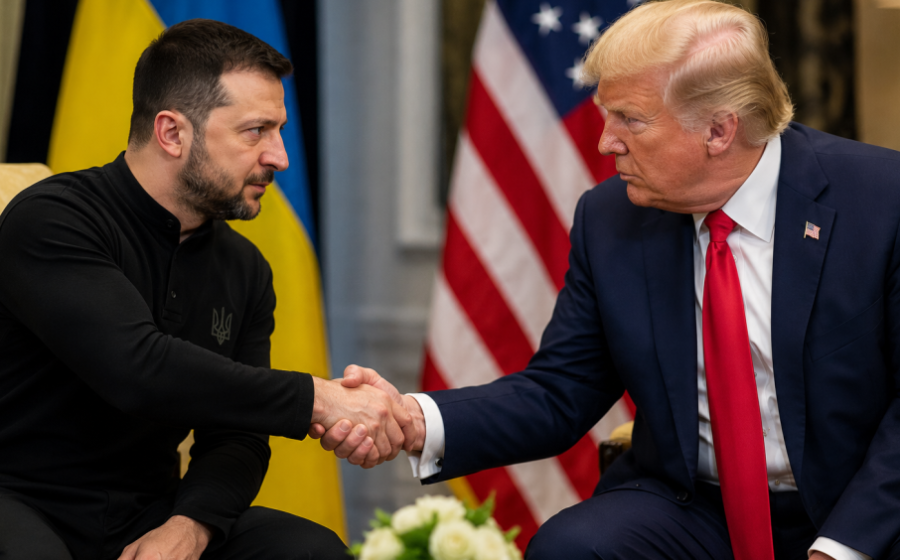
 Trump and Zelenskiy Set to Hold High-Stakes White House Summit as Washington Revives Peace Push
 Day 1 of the Healing Streams Live Healing Services Opens With Pastor Chris’ Message on “The Gospel of Jesus Christ”
 The Rising Danger of Healthcare Cyber Attacks
 Lt-Gen Sizakhele Dyantyi Appointed as New Western Cape Police Commissioner


Independent. Informed. Always on.
The Trump-Zelenskiy summit could reopen Black Sea grain corridors critical to Africa's food security. Billions in import costs and declining crop yields make the outcome urgent for dozens of nations.
Analysis: Food security and Black Sea trade
Africa faces a critical food security crossroads as the July 28 Trump-Zelenskiy White House summit targets a Russia-Ukraine ceasefire that could reopen Black Sea grain corridors serving dozens of import-dependent nations across the continent.
The Russia-Ukraine conflict yanked two of the world’s largest grain and fertilizer exporters out of reliable trade channels almost overnight. For countries like Somalia, Ethiopia, and Sudan—already battling climate-driven hunger—the disruption proved devastating. Price shocks tore through markets in Lagos, Nairobi, and Addis Ababa, squeezing household budgets and inflating government import bills.
Ukrainian officials have floated a trilateral negotiation format involving Washington, Kyiv, and Moscow. For Africa, the structure matters far less than the substance: guaranteed, uninterrupted access to affordable grain and fertilizer shipments that millions of lives depend on.
If the White House presents credible terms that Moscow considers, downstream effects on African economies could be substantial. Fertilizer cost reductions alone would relieve pressure on smallholder farmers across Sub-Saharan Africa who have slashed application rates, directly suppressing yields during a period of surging population demand.
Conversely, a summit collapse would likely trigger another wave of commodity speculation. Staple food prices would climb higher, deepening the humanitarian crisis gripping the Horn of Africa and the Sahel—regions where hunger is already at emergency levels.
At the United Nations, African delegations have consistently argued that any peace agreement must include enforceable provisions protecting food and fertilizer exports. This demand reflects hard lessons from the Black Sea Grain Initiative’s collapse in July 2023, when Russia’s withdrawal plunged commodity markets back into chaos.
The African Development Bank estimates the continent uses less than 20 kilograms of fertilizer per hectare—compared to a global average exceeding 140 kilograms. Any prolonged disruption to Russian fertilizer exports doesn’t just raise costs; it compounds a pre-existing yield gap that leaves Africa more vulnerable to each successive supply shock.
How do you think Tuesday’s summit outcome will shape food prices and stability across the continent? Share your perspective below. #InternationalNews #GM247News
Key Topics: 2007-2008 food crisis, commodity price shocks, african food imports
The current crisis echoes the 2007-2008 global food price shock, when wheat prices surged over 130% and triggered food riots in Cameroon, Egypt, Mozambique, and Burkina Faso. That episode exposed how deeply African economies depend on imported staples and how rapidly price spikes translate into political instability. The key difference in 2026 is structural: Africa's fertilizer dependency has worsened since then, with the African Development Bank estimating per-hectare usage well below 15% of the global average.
Analysts at the International Food Policy Research Institute have warned that without secured trade corridors, Africa could face a permanent step-down in agricultural productivity that no amount of emergency aid can reverse. This structural vulnerability makes the summit's outcome not just a diplomatic event but a potential inflection point for long-term continental food sovereignty.
Prepared with AI assistance; Reviewed by the GM247 Editorial Desk.
Found an error or important omission? Email corrections@gm247news.com.
World China says it monitored USS Charleston near Sabina Shoal on 20 October. The Philippines disputes Beijing’s claim; the US mission remains unconfirmed.
 World
A Nexus/BTG poll puts Flávio Bolsonaro at 50.3% and Lula at 49.7% of valid voting intentions, within the margin of error before…
 World
Qatar’s defence minister says a production hub is planned with regional and international partners, with key details still to be announced.